
The Humiliation

I was told about a novel approach to life the other day, coined by Armenian philosopher and spiritual teacher Gurdjieff – which made me sit up and listen.
The idea is to face your demons until you’ve reached a peaceful resolution with them. A resolution that means they are happy enough to leave you alone. For the sake of simplicity let’s call our demons guilt, anxiety, disappointment, humiliation – anything that forms part of the list of negative emotions associated with being a human being. And we all, I imagine, have our Demon Godfathers, the ones that come for us with all guns blazing. But my Demon Godfather might not be the same as your Demon Godfather. Mine, for example, is humiliation – the close cousin of shame, perhaps even its parent. My humiliation could be your moment in the sun. Your disappointment could be the moment I hit life’s jackpot.
But here’s the novel bit: having bid goodbye to your demons, you will never, ever talk about them again. For one, there is no need, because they are as far afield as say, the North Pole, so what is there to talk about? But more specifically, talking about your demons, Gurdjieff says, risks something called ‘over-identification’– when all your demons get tangled up in someone else’s ideas about your demons, their demons and the rest of the world, thereby muddying the waters and robbing you of any objectivity and the peace that comes with a Demon Vacuum (my words, not his).
This approach is neither emotional repression nor a social media outpouring of emotional wounds at work. It is somewhere in between: outpour first, then repress against all odds.
All I can say is: this philosopher’s theory hasn’t taken the world by storm. And I can see why.
For a start, the muddied waters of over-identification that this man wants to avoid is exactly the kind of conversation I enjoy. Something in depth, circuitous and gnarly about the human condition. A good chat with someone who’s got a furious opinion about what it is to be alive, that might have a crack at making me more furious. I’m just thinking that a pint with someone whose demons are on an extended holiday in the North Pole might be a bit less compelling?
Also, demons pop by for a visit any time of the day, or night. They are imps like that. But they are more likely to turn up ‘en masse’ during times of distress. When you’re in the weeds of a traumatic situation I can confidently say that having a chat with your demon is not high on your to-do list. You’re too busy putting out fires that the demons might have caused. Getting on the blower to a friend, or meeting them in a bar and sinking a bottle of wine over a good over-identification session, is, however, a priority.
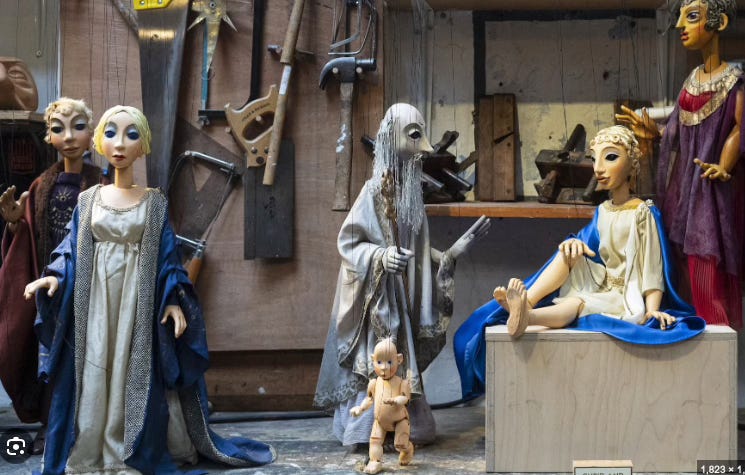
Finally, if his theory had truly taken flight then people like me would have had our jobs threatened a long time before A.I. came for them. Because people like me make a living from externalising our demons, and the demons of others. We put costumes on the little buggers, call them things like Frank and Stewart, then move them round a stage and make them say things we hope will entertain or move people so they feel a bit less alone in their humanity. If you were truly evolved I wouldn’t be able to tell you my story about the humiliating things that happened to me last weekend because you’d be too evolved to empathise with them… and besides, we’d risk over-identification.
Fine, then. I’ll tell you anyway.
I’m no shrink but I’d wager that our relationship with our Godfather Demons begins in childhood. I can count several school-based humiliations involving playgrounds and friends who said the plan was for us to whip off our dresses together at playtime only for me to follow through, and for her to remain fully clothed. Or school performances where one half of the duet froze with stage fright leaving me to sing both parts, simply tipping my head in her direction (not easy with a badger helmet on) and for her to be furious after the event that I stole her moment in the limelight.
Just this weekend gone, I’d been to see the comic Ross Noble at The Palladium. I was exiting the theatre with a large crowd, laughing as I recalled a story in the show about a puffa fish who puts on a tie one morning and goes to work. The puffa fish gets angry with someone about the photocopier, puffs up and is strangled by his own tie. Then he’s dragged out of the office by a small creature called Maureen… using his tie.
I was really laughing when I stepped on the kerb at the wrong angle and fell down in an undignified, broken sequence of moves starting with my knee. It landed on my husband’s shoe and dented it. Then I was on my elbows, knees and finally my ankle which bent under me. Until finally I was horizontal.
There were gasps and yikes . One woman said, ‘Get her back onto the kerb so she can sit up!’ And all I could think was but that’s what happens when you’re waiting for an ambulance – will you all just back off and let me untangle my old limbs?
The humiliation was worse than the pain, and the pain was immense. I was worried I’d become part of a story about the audience’s night, and not in a good way: the puffa fish story and that wasted old lush who collapsed like a shit ballerina outside the theatre.
I wasn’t wasted, drunk, high or other. I just possess limbs I rarely pay much attention to when moving. And there is something so undignified about standing up straight one minute and then landing in a pile of your own limbs the next.
And finally, it occurred to me as I lay there on that beer-sodden pavement that I hadn’t just fallen over you like you do when you’re young, like a bowling pin that pops up again. The fall I’ve had was an event. A noun. I’d had what could only be described as A Fall around which circle real-life consequences like an inability to exercise, stand, shop for groceries and walk the dog. My humiliation was dancing a little jig into a future where I was so old.
The next morning – less than 12 hours later – I was cornered at my son’s football practice by two men wearing hi-vis jackets. ‘Your dog has defecated on school grounds,’ one said loudly enough for all the other parents to hear, ‘and you were seen running from the scene.’ I was close to tears at this stage. I had been late to collect my son from football practice because everything takes twice as long with a hobble, and I was so late by the time I got there that I hobble-ran through the grounds with the dog. I was so dozy with painkillers, or so busy and worried about being late that I hadn’t realised for one moment that she had defecated in motion.
And I wanted to say to those hi-vis men that I had no idea what she had done, that I do not condone this kind of thing and I write about people who dare to throw dog turds in the wrong bin. But by then they were directing me to a place where the crime scene was marked with three cones and instructing me to clear it up.
So, you see, in externalising my humiliation and risking over-identification I have turned my own humiliation into material – a form, I suppose, of facing down my Demon Godfather. However, in doing so I have not shut up talking about it, I have written about I for all to read. And if you were utterly evolved, if you’d bid goodbye to your demons per the Armenian philosopher’s guidance, you wouldn’t know what to do with these stories.
As it is, you can just quietly note your relief that you’re not the only one who suffers the slings and arrows of outrageous and humiliating ill fortune. And isn’t that more interesting and companionable than sitting in a pub with someone so perfect they have nothing to talk about?